B2B , B2C , C2C

0

Business-to-business (B2B) describes commerce transactions between businesses, such as between a manufacturer and a wholesaler, or between a wholesaler and a retailer. Contrasting terms are business-to-consumer (B2C) and business-to-government (B2G).

The volume of B2B transactions is much higher than the volume of B2C transactions. The primary reason for this is that in a typical supply chain there will be many B2B transactions involving subcomponent or raw materials, and only one B2C transaction, specifically sale of the finished product to the end customer. For example, an automobile manufacturer makes several B2B transactions such as buying tires, glass for windshields, and rubber hoses for its vehicles. The final transaction, a finished vehicle sold to the consumer, is a single (B2C) transaction.


Business-to-consumer (B2C, sometimes also called Business-to-Customer)describes activities of businesses serving end consumers with products and/or services.

An example of a B2C transaction would be a person buying a pair of shoes from a retailer. The transactions that led to the shoes being available for purchase, that is the purchase of the leather, laces, rubber, etc. as well as the sale of the shoe from the shoemaker to the retailer would be considered (B2B) transactions.


Consumer-to-consumer (C2C) (or citizen-to-citizen) electronic commerce involves the electronically-facilitated transactions between consumers through some third party. A common example is the online auction, in which a consumer posts an item for sale and other consumers bid to purchase it; the third party generally charges a flat fee or commission. The sites are only intermediaries, just there to match consumers. They do not have to check quality of the products being offered.

Examples of C2C

This type of e-commerce is expected to increase in the future because it cuts out the costs of using another company. An example on cited in Management Information Systems, is for someone having a garage sale to promote their sale via advertising transmitted to the GPS units of cars in the area. This would potentially reach a larger audience than just posting signs around the neighborhood.


HOmesick!!!

0

hOmesick.homesick.
nape la aku ni asek2 homesick..
aku rindu umah..rindu org2 kt umah..rindu kucing2 aku.
gile rindu!!
ahh..xpe2..
sabO..da nk cuti SEM..
tp......
EXaM mENaNti aku la doe..
excited ke nervous??
tahlaa..no KOmen..
huhuu..
bengong aku ni..

yg penting.
lamBAT sgt mase berlaLu laa
;(

UTP and STP

0


Twisted pair cabling is a form of wiring in which two conductors (the forward and return conductors of a single circuit) are twisted together for the purposes of canceling out electromagnetic interference (EMI) from external sources; for instance, electromagnetic radiation from Unshielded Twisted Pair (UTP) cables, and crosstalk between neighboring pairs.


Unshielded twisted pair (UTP)


Unshielded twisted pair

Twisted pair cables were first used in telephone systems by Alexander Graham Bell in 1881. By 1900, the entire American telephone line network was either twisted pair or open wire with similar arrangements to guard against interference. Today, most of the millions of kilometres of twisted pairs in the world are outdoor landlines, owned by telephone companies, used for voice service, and only handled or even seen by telephone workers.

UTP cables are found in many ethernet networks and telephone systems. For indoor telephone applications, UTP is often grouped into sets of 25 pairs according to a standard 25-pair color code originally developed by AT&T. A typical subset of these colors (white/blue, blue/white, white/orange, orange/white) shows up in most UTP cables.

For urban outdoor telephone cables containing hundreds or thousands of pairs, the cable is divided into smaller but identical bundles. Each bundle consists of twisted pairs that have different twist rates. The bundles are in turn twisted together to make up the cable. Pairs having the same twist rate within the cable can still experience some degree of crosstalk. Wire pairs are selected carefully to minimize crosstalk within a large cable.


Unshielded twisted pair cable with different twist rates

UTP cable is also the most common cable used in computer networking. Ethernet, the most common data networking standard, utilizes UTP cables. Twisted pair cabling is often used in data networks for short and medium length connections because of its relatively lower costs compared to optical fiber and coaxial cable.

UTP is also finding increasing use in video applications, primarily in security cameras. Many middle to high-end cameras include a UTP output with setscrew terminals. This is made possible by the fact that UTP cable bandwidth has improved to match the baseband of television signals. While the video recorder most likely still has unbalanced BNC connectors for standard coaxial cable, a balun is used to convert from 100-ohm balanced UTP to 75-ohm unbalanced. A balun can also be used at the camera end for ones without a UTP output. Only one pair is necessary for each video signal.


Cable shielding


S/UTP cable format

S/UTP, also known as FTP
S/STP, also known as S/FTP.

STP cable format

S/STP cable format


Twisted pair cables are often shielded in attempt to prevent electromagnetic interference. Because the shielding is made of metal, it may also serve as a ground. However, usually a shielded or a screened twisted pair cable has a special grounding wire added called a drain wire. This shielding can be applied to individual pairs, or to the collection of pairs. When shielding is applied to the collection of pairs, this is referred to as screening. The shielding must be grounded for the shielding to work.

Screened unshielded twisted pair (S/UTP)
Also known as Fully shielded[citation needed] (or Foiled) Twisted Pair (FTP), is a screened UTP cable (ScTP).
Shielded twisted pair (STP or STP-A)
STP cabling includes metal shielding over each individual pair of copper wires. This type of shielding protects cable from external EMI (electromagnetic interferences). e.g. the 150 ohm shielded twisted pair cables defined by the IBM Cabling System specifications and used with token ring networks.
Screened shielded twisted pair (S/STP or S/FTP)
S/STP cabling, also known as Screened Fully shielded Twisted Pair (S/FTP), [1] is both individually shielded (like STP cabling) and also has an outer metal shielding covering the entire group of shielded copper pairs (like S/UTP). This type of cabling offers the best protection from interference from external sources, and also eliminates alien crosstalk[1].


Note that different vendors and authors use different terminology (i.e. STP has been used to denote both STP-A, S/STP, and S/UTP).


Advantages

  • It is a thin, flexible cable that is easy to string between walls.
  • Because UTP is small, it does not quickly fill up wiring ducts.
  • UTP costs less per meter/foot than any other type of LAN cable.


Disadvantages

  • Twisted pair’s susceptibility to the electromagnetic interference greatly depends on the pair twisting schemes (usually patented by the manufacturers) staying intact during the installation. As a result, twisted pair cables usually have stringent requirements for maximum pulling tension as well as minimum bend radius. This relative fragility of twisted pair cables makes the installation practices an important part of ensuring the cable’s performance.
  • In video applications that send information across multiple parallel signal wires, twisted pair cabling can introduce signaling delays known as skew which results in subtle color defects and ghosting due to the image components not aligning correctly when recombined in the display device. The skew occurs because twisted pairs within the same cable often use a different number of twists per meter so as to prevent common-mode crosstalk between pairs with identical numbers of twists. The skew can be compensated by varying the length of pairs in the termination box, so as to introduce delay lines that take up the slack between shorter and longer pairs, though the precise lengths required are difficult to calculate and vary depending on the overall cable length.

RCA JACK

0

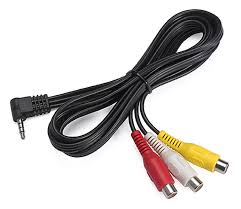
Definition: An RCA Jack or RCA Plug is a connector commonly used to connect various components in a audio-video system. It is used for analog and coaxial digital audio and composite and component video connections.
Also Known As: phono connector



Uses
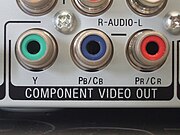
RCA jacks, here used for YPbPr video output.

In the most normal usage, cables have a standard plug on each end, consisting of a central male connector, surrounded by a ring. The ring is often segmented for flexibility. Devices mount the jack, consisting of a central hole with a ring of metal around it. The ring is slightly smaller in diameter and longer than the ring on the plug, allowing the plug's ring to fit tightly over it. The jack has a small area between the outer and inner rings which is filled with an insulator, typically plastic (very early versions, or those made for use as RF connectors used ceramic).

As with many other connectors, the RCA has been adopted for other uses than originally intended, including as a power connector, an RF connector, and as a connector for loudspeaker cables. Its use as a connector for composite video signals is extremely common, but provides poor impedance matching. RCA connectors and cable are also commonly used to carry S/PDIF-formatted digital audio, with plugs colored orange to differentiate them from other typical connections.

Connections are made by pushing the cable's plug into the female jack on the device. The signal-carrying pin protrudes from the plug, and often comes into contact with the socket before the grounded rings meet, resulting in loud hum or buzz if the audio components are powered while making connections. Continuous noise can occur if the plug partially falls out of the jack, breaking ground connection but not the signal. Some variants of the plug, especially cheaper versions, also give very poor grip and contact between the ground sheaths due to their lack of flexibility.

They are often color-coded, yellow for composite video, red for the right channel, and white or black for the left channel of stereo audio. This trio (or pair) of jacks can be found on the back of almost all audio and video equipment. At least one set is usually found on the front panel of modern TV sets, to facilitate connection of camcorders (through 3.5mm Jack to 3 RCA, also called Mini RCA plug), digital cameras, and video gaming consoles. Although nearly all audio-visual connectors, including audio, composite and component video, and S/PDIF audio can use identical 75 Ω cables, sales of special-purpose cables for each use have proliferated. Varying cable quality means that a cheap line-level audio cable might not successfully transfer component video or digital audio signals due to impedance mismatch and poor shielding quality (causing signal-to-noise ratio to be too low). Cables should meet the S/PDIF specification as defined by the international standard IEC 60958-3 for assured performance.

The male plug has a center pin which is 3.70 mm in diameter, and is surrounded by an outer shell which is 8.25 mm in diameter.


Disadvantages

"Bullet plug" variation. Notice the hollow center conductor and the single pin point for the return signal.

One problem with the RCA jack system is that each signal requires its own plug. Even the simple case of attaching a cassette deck may need four of them, two for stereo input, two for stereo output. In any common setup this quickly leads to a mess of cables, which is made worse if one considers more complex signals like component video (a total of three for video and two for analog audio or one for digital coaxial audio).

There have been numerous attempts to introduce combined audio/video connectors for direct signals[citation needed]but in the analog realm none of these have ever become universal, except in Europe where the SCART connector is very successful[citation needed]. For a time the 5-pin DIN connector was popular for bi-directional stereo connection between A/V equipment, but it has been entirely displaced[citation needed] on modern consumer devices. Though RF modulators inherently transmit combined A/V signals in video applications, they depend on broadcast television systems and RF connectors which are not universal worldwide; RF signals are also generally inferior to direct signals due to protocol conversion and the RF limitations of the three major analog TV systems (NTSC, PAL and SECAM).

Nearly all modern TV sets, VCRs, and DVD players sold in Europe have SCART connectors[citation needed], though sometimes supplemented by RCA and/or RF connectors and there are also SCART-RCA adapters.[1] Outside Europe, separate RCA connectors are the norm[citation needed], supplemented by RF connectors for backward compatibility and simplicity; though mini-DIN connectors are sometimes used for S-Video connections, composite video, component video, and analog audio (mono or stereo) all use RCA connectors unless RF is used. In the digital realm, however, combined A/V connectors are gaining ground; HDMI is commonly being used today, and DisplayPort is a potential competitor to HDMI.

For audio signals, an RCA connection is called unbalanced, and a true balanced connection is generally preferred in certain applications because it allows for the use of long cables while reducing susceptibility to external noise.


RAZAK SAT

0

RazakSAT is a Malaysian satellite carrying a high-resolution camera. It was launched into low Earth orbit by a Falcon 1 rocket on July 14, 2009. It was placed into an near-equatorial orbit that presents many imaging opportunities for the equatorial region.

BACKGROUND

This satellite is Malaysia's second remote sensing satellite after TiungSAT-1.

Originally called MACSAT, RazakSAT's payload is mainly electro-optical, carrying a Medium-sized Aperture Camera (MAC) which is a pushbroom camera with five linear detectors (one panchromatic, four multi-spectral) weighing approximately 50 kg. The entire satellite weighs at about 180 kg.

The then-Prime Minister of Malaysia, Mahathir Mohamad renamed the satellite to RazakSAT in tribute to the second Prime Minister of Malaysia, Abdul Razak or known as the "Bapa Pembangunan Malaysia" (Father of Malaysian Development) for his contribution to Malaysia's development. This was held officially during Mahathir's working visit to Astronautic Technology (M) Sdn. Bhd. (ATSB) in 2003 at its premise in Technology Park Malaysia (TPM) in Bukit Jalil, Kuala Lumpur. It has since moved to its new premises at Hicom-Glenmarie Industrial Park, Shah Alam, Selangor. ATSB is a wholly-owned company of the Minister of Finance Inc. (MOF) and reports to the Ministry of Science, Technology and Innovation (MOSTI), Malaysia.


LAUNCH

SpaceX launched RazakSAT at 03:35 UTC on July 14, 2009 using a Falcon 1 rocket. This was the fifth flight of a Falcon 1, and like the previous flights lift-off was from Omelek Island in the Kwajalein Atoll. At 05:25 UTC Elon Musk, founder and CEO of SpaceX, told a reporter the launch had been a success. "We nailed the orbit to well within target parameters...pretty much a bullseye." Musk said.


OPERATION

RazakSAT's mission plan will be carried out by engineers from ATSB. Control operations will be conducted through Malaysian National Space Agency 's Ground Station in Banting, Selangor and ATSB's ground station in Shah Alam, Selangor consisting of a Mission Control Station (MCS) and Image Receiving and Processing Station (IRPS). Another Malaysian ground station which would be able to receive images from the satellite is the Remote Sensing Malaysia groundstation in Temerloh, Pahang. The IRPS will receive and archive images for post processing and distribution to the users.
RazakSAT is unusual as it was placed at Near equatorial orbit (NEqO); unlike many other satellites of its kind that are placed on Sun-Synchronous Orbit (SSO). RazakSAT's orbital inclination will coincide with the latitude of its launch at Kwajalein, and that of the northernmost extent of Malaysia. Thus its launch will be nearly due east and quite efficient.

This is especially important because Malaysia is usually covered by the equatorial cloud bands. Normal sun-synchronous optical satellites, which may re-visit an area only once every 14 days, will almost never be able to see the ground during their pass. As a result, much optical imagery of Malaysia is years out of date.

Razaksat, on the other hand, will revisit some part of Malaysian territory every 90 minutes, maximising its ability to exploit gaps in the clouds, and substantially improving coverage of the country as a result.

10 short form in SMS

0

1. Love : Luv
2. i love you : ily
3. i miss you : imy
4. because : bcoz
5. nigth : nite
6.good : gud
7. you : u
8. be : b
9.dont know : dunno
10 : why : y

ABOUT SMS

0

Short Message Service or Silent Messaging Service (SMS) is a communication service standardized in the GSM mobile communication system, using standardized communications protocols allowing the interchange of short text messages between mobile telephone devices. SMS text messaging is the most widely used data application on the planet, with 2.4 billion active users, or 74% of all mobile phone subscribers sending and receiving text messages on their phones.[citation needed] The SMS technology has facilitated the development and growth of text messaging. The connection between the phenomenon of text messaging and the underlying technology is so great that in parts of the world the term "SMS" is used as a synonym for a text message or the act of sending a text message, even when a different protocol is being used.

SMS as used on modern handsets was originally defined as part of the GSM series of standards in 1985[1] as a means of sending messages of up to 160 characters (including spaces), to and from GSM mobile handsets.[2] Since then, support for the service has expanded to include other mobile technologies such as ANSI CDMA networks and Digital AMPS, as well as satellite and landline networks.[citation needed] Most SMS messages are mobile-to-mobile text messages, though the standard supports other types of broadcast messaging as well.


SMS today

Commercially SMS is a massive industry in 2006 worth over 81 billion dollars globally.[23] SMS has an average global price of 0.11 USD while costing providers almost nothing. Mobile networks charge each other so-called interconnect fees of at least £0.03 when connecting between different phone networks[24]

MESH topolgy

0

This diagram illustrates the mesh network topology. A mesh topology provides redundant communication paths between some or all devices (partial or full mesh).

Mesh Network Topology Diagram

Mesh Network Topology

tree network topolgy

0

This diagram illustrates the tree network topology. A tree topology integrates the star and bus topologies in a hybrid approach to improve network scalability.

Tree Network Topology Diagram

Tree Network Topology

windows

0

New Windows 7 taskbar


Ease of Access Center


APPLE MAC OS


MACOS" redirects here. For the American humanities teaching program, see Man: A Course of Study.

Mac OS logo.

Mac OS is the trademarked name for a series of graphical user interface-based operating systems developed by Apple Inc. (formerly Apple Computer, Inc.) for their Macintosh line of computer systems. The Macintosh user experience is credited with popularizing the graphical user interface. The original form of what Apple would later name the "Mac OS" was the integral and unnamed system software first introduced in 1984 with the original Macintosh, usually referred to simply as the System software. It was a trimmed-down version of the operating system underpinning Apple's earlier Lisa product.

Apple deliberately downplayed the existence of the operating system in the early years of the Macintosh to help make the machine appear more user-friendly and to distance it from other operating systems such as MS-DOS, which was more arcane and technically challenging. Much of this early system software was held in ROM, with updates typically provided free of charge by Apple dealers on floppy disk. As increasing disk storage capacity and performance gradually eliminated the need for fixing much of an advanced GUI operating system in ROM, Apple explored cloning while positioning major operating system upgrades as separate revenue-generating products, first with System 7.1 and System 7.5, then with Mac OS 7.6 in 1997.

Early versions of the Mac OS were compatible only with Motorola 68000-based Macintoshes. As Apple introduced computers with PowerPC hardware, the OS was upgraded to support this architecture as well. Mac OS 8.1 was the last version that could run on a 68000-class processor (the 68040). Mac OS X, which has superseded the "Classic" Mac OS, is compatible with both PowerPC and Intel processors through version 10.5 ("Leopard"). Version 10.6 ("Snow Leopard") supports only Intel processors.


MAC OS X


OSXLeopard.png
Snow Leopard Desktop.png
Screenshot of Mac OS X v10.6 "Snow Leopard"
Company / developer Apple Inc.
OS family Unix (Mac OS X 10.5 and later)[1][2]
Unix-like (all previous versions)
Working state Current
Source model Closed source (with open source components)
Latest stable release 10.6.1 (2009-09-10; 23 days ago) [+/−]
Supported platforms IA-32, x86-64 (32-bit & 64-bit), PowerPC (32-bit & 64-bit up to version 10.5), ARMv6 and ARMv7-A (for iPhone OS)
Kernel type Hybrid kernel based on the Mach microkernel
Default user interface Aqua
License Proprietary EULA
Website Apple - Mac OS X


knowing myclassmate SCCT1023[A]

0

miss azura..sorry for the late to post this assignment ;)


1)Name: Izahar
Come from: Sg.Petani,Kedah
Favourite Colour: Green,Yellow
Hobbies: Surfing Internet
Favourite Place to hangout: Beach

2)Name: Yusuf
Come from: Selangor
Favourite Colour: White,Red
Hobbies: On-line
Favourite Place to hangout: Kuala Lumpur

3)Name: Loges
Come from: Kelantan
Favourite Colour: Pink
Hobbies: Listen to Music
Favourite Place to hangout: Tumpat

4)Name: Mit
Come from: Perlis
Favourite Colour: Green
Hobbies: Chatting
Favourite Place to hangout: Shopping Centre

5)Name: Lina
Come from: Sabah
Favourite Colour: Green
Hobbies: Listen Radio
Favourite Place to hangout: Room

6)Name: Mimi
Come from: Ipoh,Perak
Favourite Colour: Black
Hobbies: Singing
Favourite Place to hangout: Hometown

7)Name: Lea
Come from: Kuala Kangsar,Perak
Favourite Colour: White
Hobbies: Reading
Favourite Place to hangout: Food court

8)Name: Nadia
Come from: Taiping,Perak
Favourite Colour: Purple
Hobbies: Surf-Internet
Favourite Place to hangout : Shopping centre


9)Name: Nad
Come from: Kedah
Favourite Colour: Blue
Hobbies: Read Novel
Favourite Place to hangout : Room

10)Name: Hanis
Come from: Penang
Favourite Colour: Purple
Hobbies: Surf-Internet, Reading
Favourite Place to hangout: Shopping Centre

11)Name: Yana
Come from: Sabah
Favourite Colour: All colour
Hobbies: Surf-Internet
Favourite Place to hangout: Times Square,Sg.Wang

12)Name: Ummi
Come from: Kedah
Favourite Colour: Red
Hobbies: Chatting
Favourite Place to hangout: Jitra


13)Name: Roslin
Come from: Johor
Favourite Colour: White
Hobbies: Chatting
Favourite Place to hangout: Friend’s room

14)Name: Kalai
Come from: Kedah
Favourite Colour: White,Black
Hobbies: Chatting
Favourite Place to hangout: Langkawi

15)Name: Ridwan
Come from: Nigeria
Favourite Colour: Blue
Hobbies: Talking
Favourite Place to hangout: Kuala Lumpur


16)Name: Za
Come from: Terengganu
Favourite Colour: Blue
Hobbies: Chatting
Favourite Place to hangout: Shopping centre

17)Name: Nurul
Come from: Indonesia
Favourite Colour: Brown
Hobbies: Travelling
Favourite Place to hangout: Shopping centre

18)Name: Seha
Come from: Teremgganu
Favourite Colour: Black,White
Hobbies: Chatting
Favourite Place to hangout: Putrajaya


19)Name: Miey
Come from: Perlis
Favourite Colour: White,Red,Black
Hobbies: Climbing
Favourite Place to hangout: Café


20)Name: Naqia
Come from: Johor
Favourite Colour: Blue
Hobbies: Reading
Favourite Place to hangout: Shopping Mall

21)Name: Sandra
Come from: Sabah
Favourite Colour: Red
Hobbies: Chatting
Favourite Place to hangout: Room

22)Name: Ah Yien
Come from: Sarawak
Favourite Colour: Purple
Hobbies: Read Novel
Favourite Place to hangout: Bookshop

23)Name: Chan
Come from: Johor
Favourite Colour: Yellow
Hobbies: Listen to Music
Favourite Place to hangout: Waterfall


24)Name: Pei Chin
Come from: Pahang
Favourite Colour: Blue
Hobbies: Jogging
Favourite Place to hangout: Kuala Lumpur

25)Name: Chuah
Come from: Taiping,Perak
Favourite Colour: Pink
Hobbies: Singing
Favourite Place to hangout: Shopping Centre

26)Name: Sook Peng
Come from: Pahang
Favourite Colour: Blue
Hobbies: Watch movie
Favourite Place to hangout: Shopping Centre

27)Name: Yen Pin
Come from: Pahang
Favourite Colour: Pink
Hobbies: Shopping
Favourite Place to hangout: Shopping Mall


28)Name: Fung
Come from: Sarawak
Favourite Colour: Purple
Hobbies: Watch TV
Favourite Place to hangout: Beach

29)Name: Ying
Come from: Kedah
Favourite Colour: Purple
Hobbies: Singing
Favourite Place to hangout: Shopping Mall

30)Name: Yaw
Come from: Kuala Lumpur
Favourite Colour: White
Hobbies: Sleeping
Favourite Place to hangout: YAB

31)Name: Aaron
Come from: Penang
Favourite Colour: Black
Hobbies: Football
Favourite Place to hangout: Pub


32)Name: Wai Kee
Come from: Melaka
Favourite Colour: Green
Hobbies: Badminton
Favourite Place to hangout: Cafe

33)Name: Kong
Come from: Kuala Lumpur
Favourite Colour: Black
Hobbies: Football
Favourite Place to hangout: YAB Cafe

34)Name: Anggie
Come from: Indonesia
Favourite Colour: Blue
Hobbies: Tennis
Favourite Place to hangout: Cinema

35)Name: Simon
Come from: Penang
Favourite Colour: Purple
Hobbies: Piano
Favourite Place to hangout: Red Box

36)Name: Katherine
Come from: Klang,Selangor
Favourite Colour: Blue
Hobbies: Badminton
Favourite Place to hangout: Shopping Mall

37)Name: Sam
Come from: Perak
Favourite Colour: Silver
Hobbies: Listen to Music
Favourite Place to hangout: Cafe

38)Name: Fishi
Come from: Pahang
Favourite Colour: Red
Hobbies: Badminton
Favourite Place to hangout: Café

49)Name: C Plus
Come from: Penang
Favourite Colour: Purple
Hobbies: Play Computer
Favourite Place to hangout: Shopping Centre

my EG portal

0


HELPDESK


LOGIN & REGISTRATION
User ID :
Password :


ANNOUNCEMENT

:: TNB ::

Please be informed that TNB will be upgrading its servers. TNB services will not be available during the following period:

Start : Saturday, 15/08/2009 @ 08:00 AM
End : Saturday, 15/08/2009 @ 05:00 PM

Duration of Time : 9 hours


Our apologies for any inconvenience.

DOWNLOAD FORM

CONTACT US
Address :
Lot 5.01, Level 5,
KPMG Tower, No.8, First Avenue,
Persiaran Bandar Utama, Bandar Utama,
47800 Petaling Jaya, Selangor.
Telephone :
03-7801 8900
(Helpdesk)
03-7801 8888
(Telemarketing)
Fax :
03-7801 8889


LINKS

WHAT'S NEW
BUY AUTO INSURANCE/TAKAFUL HERE - [CLICK HERE]
ROAD TAX RENEWAL - [CLICK HERE]
FREQUENTLY ASKED QUESTIONS - [CLICK HERE]

You can now renew your road tax and insurance online 2 (two) months before the actual expiry date of your road tax.

PDRM
PDRM SUMMONS ALERT REGISTRATION - [FREE]

For selected summons that are paid within 1 month of issuance, PDRM offers a discount scheme of 30% to 50% from the original amount.

Normally you do not receive any notices that you have been issued summons until after this one month grace period. Therefore, you have no choice but to pay the summons amount in full.

By subscribing to MyEG's new FREE service, we will inform and remind you via email if you have any new summons. Now you will always have the option to be eligible for this discount. Furthermore, as you receive the summons notification early, you can still remember who was driving the car at that time and be more careful in the future.

In the event that you are very certain that you were never in the area mentioned in the summons (as you have received the summons early), you may refer to PDRM for a review on the photos taken by paying PDRM a small fee.

PDRM Summons Alert Free Registration
PDRM Summons Payment (Login Required)


OTHER SERVICES

RENEWAL OF DRIVING LICENSES (CDL) FOR ALL CLASSES - [CLICK HERE]


JABATAN PENDAFTARAN NEGARA (JPN)
LOT 2G5, PRECINT 2,
PUSAT PENTADBIRAN KERAJAAN PERSEKUTUAN
62251 W.P PUTRAJAYA

Since June 2007, we have located an e-kiosk at the lobby of JPN Putrajaya.
Services available at this kiosk include :-

1) NORMAL MYKAD REPLACEMENT
2) MYKAD REPLACEMENT DUE TO CARD DAMAGE / CHIP DAMAGE
3) MYKAD REPLACEMENT DUE TO LOSS
4) LOADING JPJ / IMM INFORMATION INTO MYKAD
5) PRINT MYKAD CHIP CONTENT

OUR COMPANY
MyEG Services Berhad is a concessionaire for the Malaysian E-Government MSC Flagship Application. Our role as a Service Provider for the E-Services component essentially provides the electronic link between the Government and citizens/businesses.

Through our portal, we offer the Malaysian public a single point of contact between the Government and the people it serves. This portal enables Malaysians to dynamically interact with numerous agencies within the Federal, State and the Local Government machinery providing services ranging from information searches to licence applications.

To cater the services which require physical presence/interaction, MyEG has set up E-Service Centres located throughout the country to complement our online presence. We believe that through this dual approach, we can enhance the relationship and quality of interaction between the Government of Malaysia and it’s citizens.

SHORTCUTS
DRIVING LICENSE RENEWAL
AUTO INSURANCE RENEWAL
ROAD TAX RENEWAL
LDL APPLICATION
PDRM SUMMONS ALERT

MSC

SERVICES
RENEW YOUR ROAD TAX NOW!!!


All logos and trademarks on this site are the property of their respective owners.
© 2006 by MyEG Services Berhad. All Rights Reserved - Privacy policy.